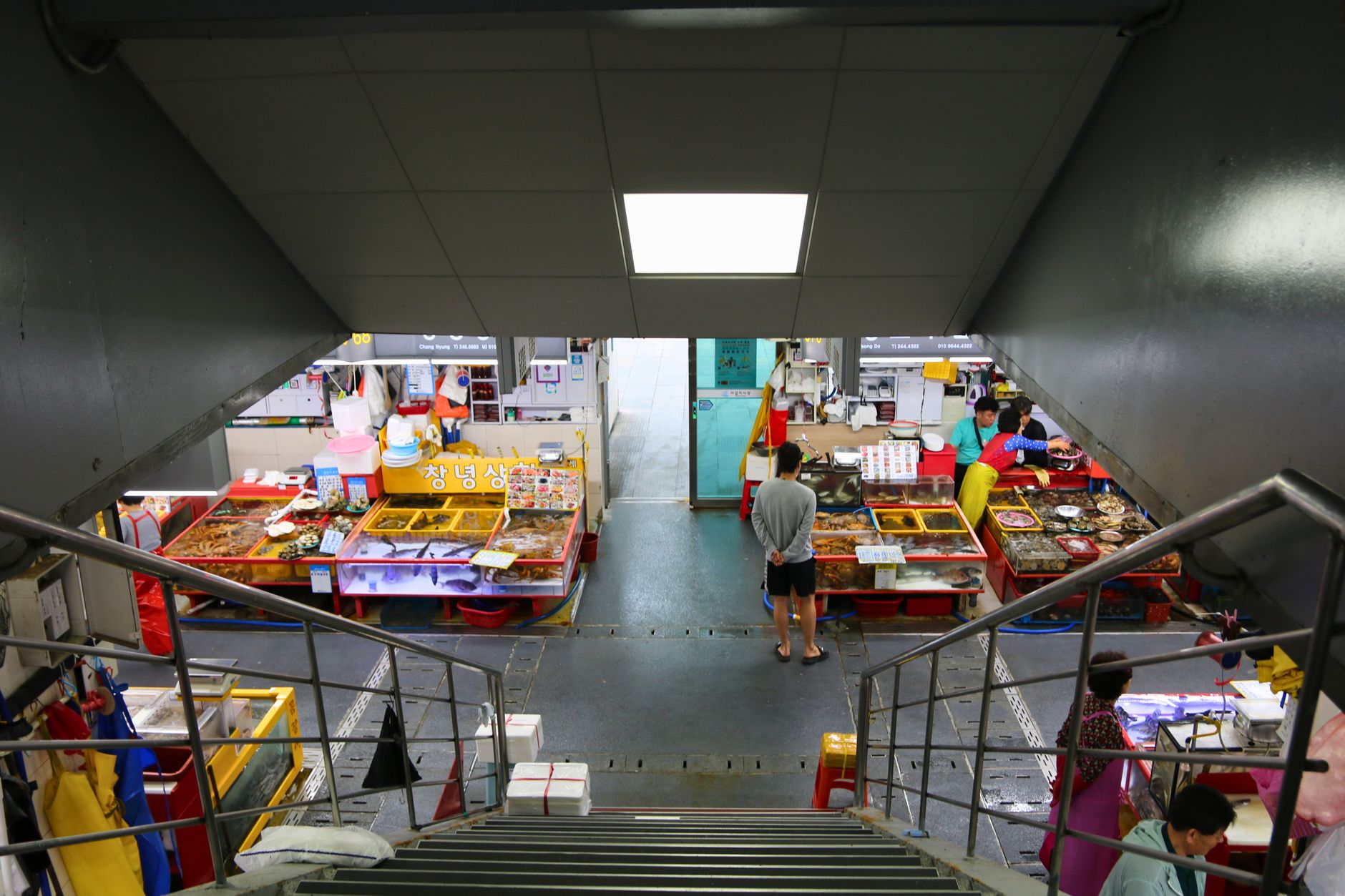
Before the tour buses roll in and the selfie sticks come out, Jagalchi Market in Busan, South Korea is already alive — salt-stung air, clattering ice trays, and vendors sliding platters of raw fish across wet counters at half the price you’ll pay two hours later. This is the seafood breakfast ritual that locals guard quietly, and this guide gives you the exact roadmap to experience it.
Best Timing
The sweet spot is early morning, between 05:30 and 08:00. That’s when overnight fishing hauls arrive directly at the docks adjacent to the market, and first-floor vendors set up temporary “morning stalls” (새벽 좌판) that disappear by 09:30. May through October brings warm, dry mornings ideal for eating on outdoor platforms overlooking Busan’s waterfront — but even a gray November dawn has its atmospheric charm here. Avoid national holidays (Chuseok, Lunar New Year) when stall prices can spike 20–30% and crowds make navigation genuinely difficult.
Weekdays are dramatically calmer than weekends. If the upload date is Thursday, that’s already a good sign — Thursday mornings see roughly half the foot traffic of a Saturday. Arriving before 07:00 on a weekday puts you in the company of restaurant buyers, fishermen’s families, and a handful of in-the-know locals — the exact crowd that signals freshness and value.
Core Experiences
Floor 1 Morning Raw Fish Stalls (1층 새벽 횟감 좌판)
The ground floor of Jagalchi’s main building transforms before dawn. Vendors who have been unloading catches since 04:00 arrange sliced gwang-eo (flatfish), do-mi (sea bream), and live octopus directly onto chipped plastic trays packed in crushed ice. The atmosphere is theatrical — fluorescent lights bounce off wet concrete, ajummas in rubber aprons shout prices in rapid-fire Busan dialect, and the fish is so fresh it still moves. This is where regulars come for their weekly hoe fix before work, paying market-rate wholesale prices rather than tourist-menu markups. A full platter of mixed sashimi (모듬회) for two people costs roughly ₩15,000–₩20,000 here — the same platter runs ₩35,000+ upstairs.
📍 Jagalchi Market, 52 Jagalchihaean-ro, Nam-gu, Busan · 💰 ₩15,000–₩20,000 per platter · ⏰ 05:00–09:30 (morning stalls only) · ⭐ 4.7
🔑 What locals know: Ask for “오늘 새벽 거” (“today’s dawn catch”) — vendors will point you to whichever fish came in that morning rather than yesterday’s leftovers.
Grilled Mackerel at Dock-Side Pojangmacha (고등어 구이 포장마차)
Just outside Jagalchi’s main building, a row of pojangmacha (street tent stalls) faces the dock and serves godeungeo-gui — charcoal-grilled mackerel — from first light. Mackerel caught in the Korea Strait is famously fatty and rich, and vendors split the fish open, rub it with coarse sea salt, and grill it over wood charcoal right in front of you. Paired with a bowl of white rice, kimchi, and doenjang-jjigae (fermented soybean paste stew), this is arguably the most complete, most affordable breakfast in Busan. Each set costs around ₩8,000–₩10,000. The smoke, the harbor view, and the rhythm of fishing boats in the background make this a genuinely cinematic meal.
📍 Outdoor pojangmacha row, east side of Jagalchi Market main building · 💰 ₩8,000–₩10,000 per set · ⏰ 05:30–11:00 · ⭐ 4.5
🔑 What locals know: Seats closest to the dock fill up first. Arrive by 06:30 to claim a waterfront spot; stragglers after 08:00 often end up facing the road instead.
Live Sea Squirt (멍게) and Sea Cucumber (해삼) Counter
For the adventurous eater, the northeast corner of Jagalchi’s first floor houses a cluster of vendors specializing in meongge (sea squirt) and haesam (sea cucumber) — two creatures that define the flavor of the South Sea and rarely make it onto tourist menus. Sea squirt has a briny, iodine-forward punch that is polarizing but unforgettable; sea cucumber is chewy, mild, and often dipped in cho-gochujang (vinegared chili paste). Vendors serve them freshly sliced to order, in small dishes (₩5,000–₩8,000 per portion), making this the most affordable way to taste something genuinely off-itinerary. The stalls are identifiable by the large tanks of live specimens stacked floor-to-ceiling.
📍 Northeast corner, 1F, Jagalchi Market main building · 💰 ₩5,000–₩8,000 per portion · ⏰ 06:00–18:00 · ⭐ 4.4
🔑 What locals know: Point at what you want and hold up fingers for quantity — no Korean required. Vendors here are accustomed to non-verbal orders and will smile and slice.
2F Halmae Sikdang (2층 할매 식당가 — Grandma Restaurant Row)
Climb the stairs to the second floor and the atmosphere shifts from raw market chaos to something warmer: a row of small, family-run sikdang (restaurants) operated mostly by older women — halmae (grandmothers) in local parlance — who have been cooking here for decades. These establishments serve cooked seafood meals: haemul-jjim (braised spicy seafood), agujjim (spicy braised monkfish), and sundubu-jjigae with fresh clams. Prices are honest — ₩10,000–₩15,000 per person for a full meal with banchan — and portions are generous. The women who run these stalls have their own loyal customer bases of fishermen and market workers, which is the clearest possible indicator of quality.
📍 2F, Jagalchi Market main building, multiple stalls · 💰 ₩10,000–₩15,000 per person · ⏰ 07:00–15:00 (varies by stall) · ⭐ 4.6
🔑 What locals know: The stalls closest to the stairwell get the most foot traffic; walk to the far end of the row for the quieter, often older establishments that have been there the longest.
Jagalchi Outdoor Tent Market (야외 노점 시장)
Beyond the main building, a sprawling outdoor tent market stretches along the waterfront, selling everything from dried myeolchi (anchovies) and salted gejang (raw crab) to live abalone and stone pots of jeonbok-juk (abalone porridge). The abalone porridge, in particular, is a local morning institution — silky, green-tinged from blended abalone entrails, and ladled out of enormous pots that have been simmering since before dawn. A bowl costs ₩12,000–₩15,000 and is considered a restorative breakfast by many Busan residents. The outdoor market is also where you’ll find the best dried seafood prices for take-home gifts — myeolchi and gim (roasted seaweed) are especially good value.
📍 Outdoor tent area along Jagalchihaean-ro, west of main building · 💰 ₩12,000–₩15,000 for jeonbok-juk · ⏰ 05:30–12:00 · ⭐ 4.5
🔑 What locals know: Dried seafood prices in the outdoor tent market are roughly 15–20% cheaper than the souvenir shops on Nampo-dong’s main street — stock up here before leaving.
Recommended Route
This half-day itinerary works best on a weekday morning, starting no later than 06:30.
06:30 — Arrive at Jagalchi Station (Line 1, Exit 10). Walk 5 minutes toward the dock.
06:35 — Head straight to the dock-side pojangmacha for grilled mackerel breakfast. Order a godeungeo-gui set and eat while watching fishing boats. (~30 minutes)
07:10 — Enter the main building and go to the 1F morning raw fish stalls. Browse the overnight catch, pick a vendor with a busy local clientele, and order a small modum-hoe platter. (~35 minutes)
07:50 — Move to the northeast corner for a small plate of meongge or haesam — two bites, big flavor. (~15 minutes)
08:10 — Head upstairs to the 2F halmae sikdang row. Walk to the far end and choose a stall for a cooked meal — agujjim or haemul-jjim with rice and banchan. (~40 minutes)
08:55 — Exit the main building and walk west into the outdoor tent market. Browse dried seafood for gifts, and finish with a bowl of jeonbok-juk if there’s still room. (~40 minutes)
09:40 — Walk 10 minutes north to Nampo-dong for coffee and a stroll, or catch Line 1 back toward central Busan.
Total active time: ~3.5 hours. Total walking: under 1.5 km.
Budget · Transport · Booking
Getting there: Jagalchi Station on Busan Metro Line 1, Exit 10. The market is a 5-minute walk. From Busan KTX station (Busan Station), it’s 3 stops and approximately ₩1,400 by metro. Taxis from Haeundae take 25–40 minutes and cost around ₩15,000–₩20,000 depending on traffic.
Realistic food budget per person:
- Grilled mackerel set: ₩8,000–₩10,000
- Raw fish platter (split between 2): ₩8,000–₩10,000 per person
- Sea squirt/sea cucumber: ₩5,000–₩8,000
- 2F cooked meal: ₩10,000–₩15,000
- Abalone porridge: ₩12,000–₩15,000
- Total: ₩43,000–₩58,000 per person for a full morning of eating — roughly USD 32–43.
Entrance: Free. No tickets required for any floor of the market.
Booking: No reservations accepted or needed at any of these stalls. The 2F halmae restaurants occasionally run out of popular dishes (agujjim in particular) by 10:00 — arriving before 08:30 is the safest strategy.
Cash vs. card: Most morning stalls are cash only. Bring at least ₩50,000–₩70,000 in small bills. Some 2F restaurants now accept card, but do not rely on it. The nearest ATM is inside the Jagalchi Station building (accepts foreign cards).
Must-Know Tips
- 🐟 Freshness signal: A busy stall with local restaurant buyers is always a better indicator than any signage. If a vendor is selling to a restaurant owner in an apron, that’s the stall to choose.
- 💵 Cash is king: Bring ₩50,000–₩70,000 in small bills. Many morning stalls do not accept cards, and splitting bills is common — have ₩1,000 and ₩5,000 notes ready.
- 👟 Wear rubber-soled shoes: The floors on Level 1 are perpetually wet. Sandals or smooth-soled shoes are a slip hazard, especially in the pre-dawn hours when hosing-down happens frequently.
- 📷 Photography etiquette: Always ask before photographing vendors or their stalls — a smile and a gestured camera question is universally understood. Some older vendors prefer not to be filmed; respect this immediately.
- 🗣️ Language shortcut: The phrase “이거 얼마예요?” (“How much is this?”) plus pointing is all the Korean needed. Prices are often written on small boards in numbers — universally readable.
- ⏰ The 09:30 cutoff is real: Morning stalls genuinely begin breaking down by 09:30–10:00. Don’t rely on arriving at 09:00 and expecting the full experience — the best vendors are often sold out or packing up.
Closing
Jagalchi Market at dawn is one of those rare travel experiences that still feels genuinely local — not because it’s been hidden away, but because it requires the discipline to wake up before the tourist day begins. The smell of charcoal smoke over mackerel, the sound of dialect-thick bargaining, the cold salt air coming off the harbor — these are the textures that stay long after the trip ends.
The one actionable move: Set your alarm for 05:45, skip the hotel breakfast, and take Line 1 to Jagalchi Station. Everything else, the vendors will handle.
🏨 Where to Stay
 Hotel Homers⭐ 4.0 · 8.4/10 (3,716) · $129 /night
 Best Louis Hamilton Hotel GwangAn⭐ 3.0 · 7.9/10 (2,626) · $103 /night
 The First Ocean Gwangan⭐ 3.0 · 8.4/10 (446) · $110 /night
Agoda affiliate link — clicks go to the price-comparison page.